The STAR Method: A Complete Guide to Structuring Behavioral Interview Answers
Published September 19, 2026 · MockStar editorial
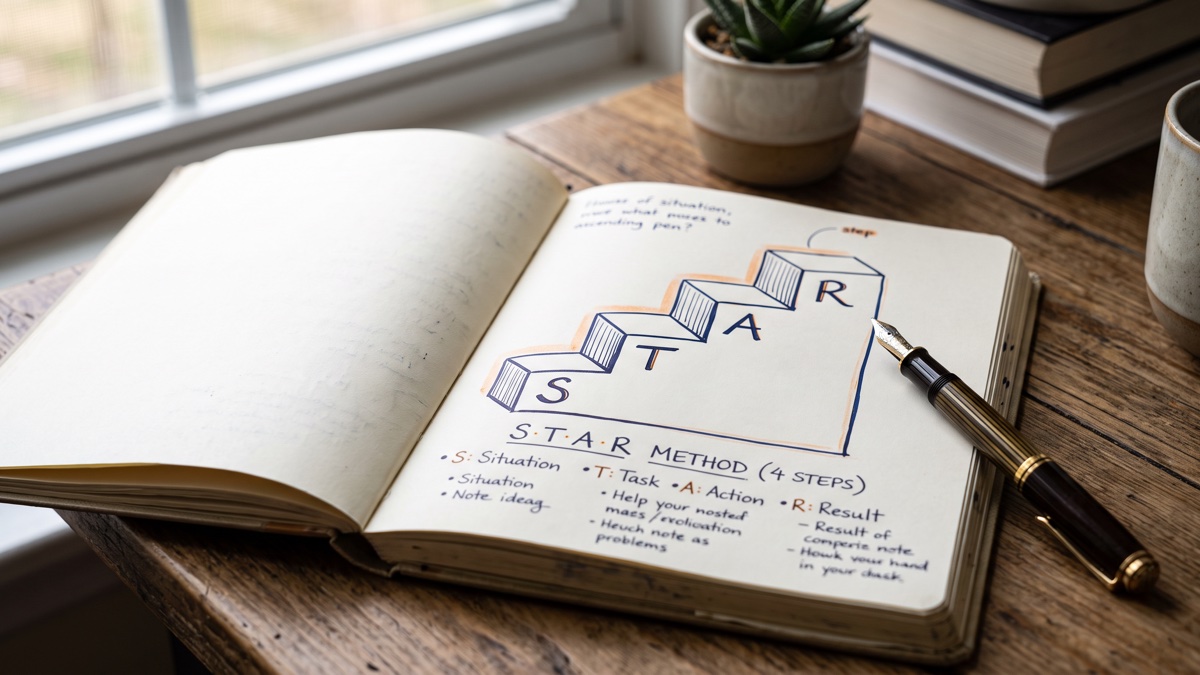
Behavioral interview questions — "Tell me about a time you failed," "Describe a conflict with a coworker" — trip up even strong candidates, not because they lack experience, but because they lack structure. Under pressure, most people ramble: they spend three minutes on background, thirty seconds on what they actually did, and forget to say how it ended. The STAR method exists to fix exactly that.
STAR stands for Situation, Task, Action, Result. It is a four-part skeleton for any "tell me about a time" question, and interviewers at companies from startups to Amazon explicitly listen for it. This guide explains each stage, the mistakes candidates make in each one, and how to practice until the structure becomes automatic.
Situation: set the scene in 30 seconds
The Situation gives the interviewer just enough context to understand the stakes. Where were you working? What was happening? Why did it matter? The most common mistake is over-investing here — candidates love context because it is safe, and burn half their answer on org charts and project history.
A good Situation is two or three sentences: "In my role as a data analyst at a SaaS company, annual churn had climbed to 18 percent, and the customer success team was finding out about unhappy accounts only during renewal calls." That is enough. The interviewer now knows the setting, the problem, and why it was expensive.
Task: isolate YOUR responsibility
The Task is one or two sentences defining what you personally were responsible for. This stage exists because interviewers are evaluating you, not your former team. "We were asked to fix onboarding" tells them nothing; "I owned the activation metric and was asked to lift it from 34 to 45 percent in two quarters" tells them exactly what to grade.
A useful test: if you removed the Task sentence, would the interviewer be able to tell what was yours versus the team's? If not, make it explicit.
Action: the heart of the answer
Action is where offers are won and lost, and it should take roughly 60 percent of your total answer time. Walk through what you did, step by step, in the first person: "I interviewed five CSMs… I prototyped a five-signal model… I ran it in shadow mode for six weeks." Strong verbs, specific steps, real sequence.
Crucially, include at least one decision and its reasoning. Anyone can follow a playbook; interviewers probe for judgment. "I nearly defended the complex 14-signal model, but rebuilt it around five signals a CSM could explain in one sentence, because adoption depended on trust" reveals more about you than any list of tools.
Result: numbers, then reflection
Close with the outcome, quantified whenever possible: "Flagged accounts renewed at 71 percent versus 42 percent before the tool, and churn fell to 13 percent." Numbers beat adjectives — "it went well" is unverifiable, percentages are not.
Then add one sentence of reflection: what you learned, or what you would do differently. This is the most skipped stage and the most differentiating. It signals self-awareness, which is precisely the trait behavioral interviews exist to measure.
Common STAR mistakes to avoid
- Spending more than a third of the answer on Situation and Task.
- Saying "we" throughout the Action stage so your contribution disappears.
- Ending on the outcome without a reflection or lesson.
- Choosing a story with no real stakes — a conflict over code formatting reveals nothing.
- Memorizing answers word for word, which collapses under the first follow-up question.
How to practice STAR until it is automatic
Prepare five or six stories from your career that each flex to multiple questions: a failure, a conflict, a leadership moment, a tight deadline, an ambiguous problem. For each, write four bullet points — one per STAR stage — not a script. Then rehearse out loud with a timer, aiming for 90 to 120 seconds per answer. Record yourself once; the gap between how you think you sound and how you sound is the entire point of practice.
STAR is not a script. It is scaffolding — once the structure is automatic, your personality can finally come through.
Put STAR into practice
Pick a real behavioral question and build your answer step by step with the free STAR builder.
Build a STAR answer now